How would you react if you found out that your partner has been unfaithful? Or that the slacker in your high school class is now immensely successful? We make predictions about how people will act all the time - what happens when those predictions are wrong? In order to form cohesive representations of others, we often need to integrate conflicting information about them. Furthermore, our pre-existing feelings towards these people, as well as our motivations and goals, influence how and when we update our beliefs about them.
This process can happen in a number of different contexts. For example, when you witness a close friend in a novel environment, you may witness them act in novel ways. To investigate this phenomenon, we had groups of friends assess each other before and after completing a virtual escape room together. In another study, I analyzed tweets about public figures accused of sexual assault to understand how people change their perceptions of others’ morality when they commit a moral violation.
Currently, I am running a study on first impressions and the dating process to investigate how our socioemotional motivations affect what we remember about an interaction. I’m also interested in how impressions are dynamically updated in response to feedback from the potential romantic partner.
It’s also possible to update one’s beliefs about oneself: What did we used to be like, and when/how/why did we change? In this study, I investigated how self-views, and memory for previous self-views, changed in response to the 2020 U.S. presidential election.
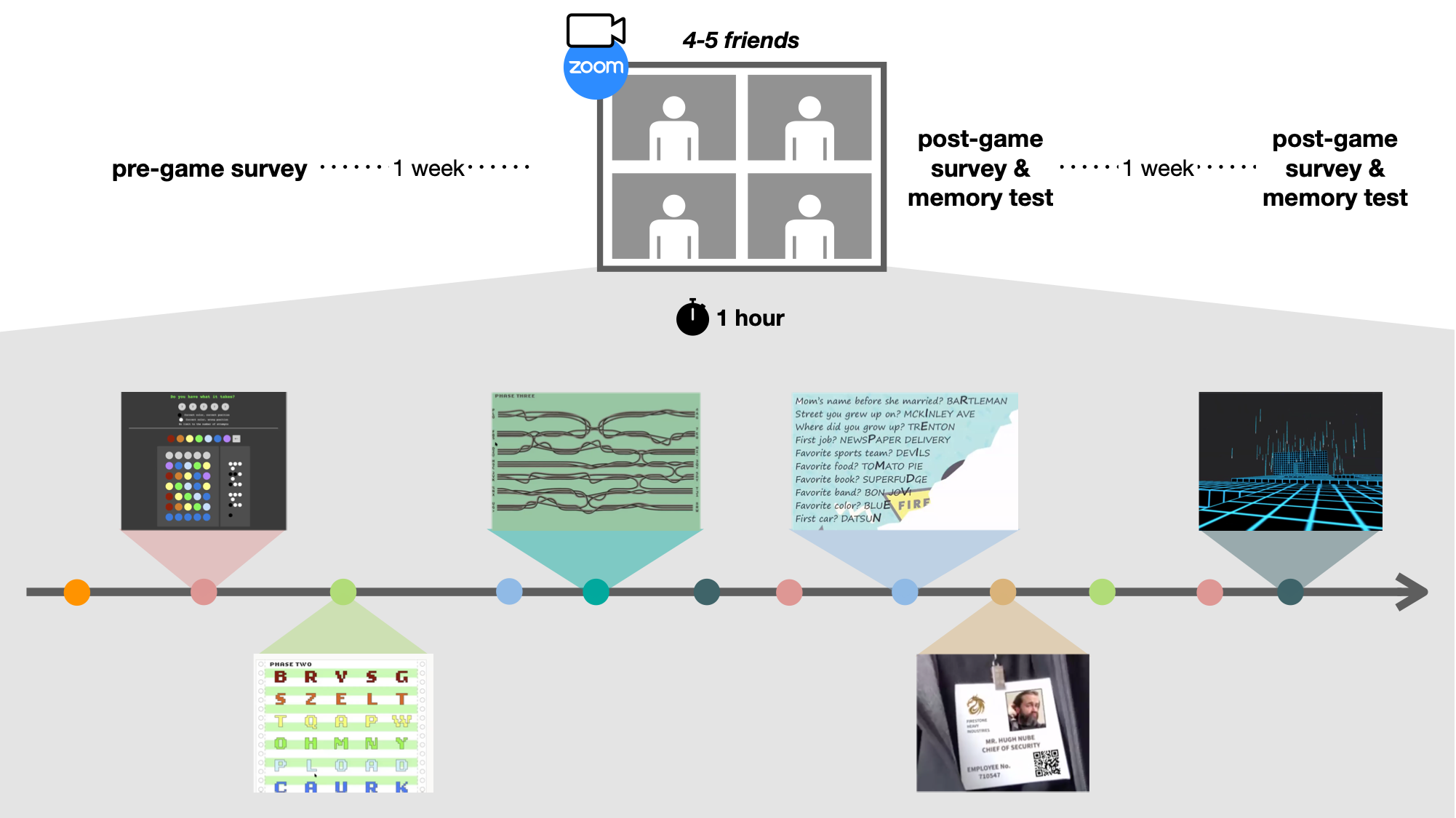 A schematic of the virtual escape room study. Image made by Wangjing Yu, a collaborator on the project.
Related work
Silver, B.M., Ochsner, K.N. (2024). Changes in Online Moral Discourse About Public Figures During #MeToo. Affec Sci. https://doi.org/10.1007/s42761-024-00250-4
Silver, B.M., Meyer, M.L., Davachi, L., Ochsner, K.N. (under review). “Did I really used to be like that?” Self-views and memory across the 2020 U.S. presidential election. https://doi.org/10.31234/osf.io/pq4k5
Silver, B.M., Yu, W., Davachi, L., Ochsner, K.N. (in revisions). What are my friends really like? How we change our perceptions of familiar others’ traits and actions. https://doi.org/10.31234/osf.io/n75xc
Abstracts from the 2022 Annual Meeting of the Society for Affective Science. Affec Sci (2023). https://doi.org/10.1007/s42761-022-00175-w
Silver, B.M., Baldassano, C., Davachi, L., Ochsner, K.N. Always on my mind: The role of the dmPFC in responding to social feedback from potential romantic partners. Poster presented at the Social and Affective Neuroscience Society. Toronto, ON. 2024. View my poster here.
Silver, B.M., Baldassano, C., Davachi, L., Ochsner, K.N. Do you like me back? Impression formation and motivated memory for potential romantic partners. Poster presented at the Social and Affective Neuroscience Society. Santa Barbara, CA. 2023. View my poster here.
Silver, B.M., Yu, W., Davachi, L., Ochsner, K.N. What are my friends really like? Motivated perceptions after completing a virtual escape room. Poster presented at the Society for Affective Science. Long Beach, CA. 2023. View my poster here.
Silver, B.M., Baldassano, C., Davachi, L., Ochsner, K.N. Romantic remembering: Social information determines individualized reward value and motivates memory. Poster presented at the Social and Affective Neuroscience Society. Online. 2022.
Silver, B.M., Ochsner, K.N. Morality and #MeToo: Motivated impression updating on Twitter. Flash talk presented at the Society for Affective Science; Online. 2022.